Aerospace Studies - Air Force ROTC
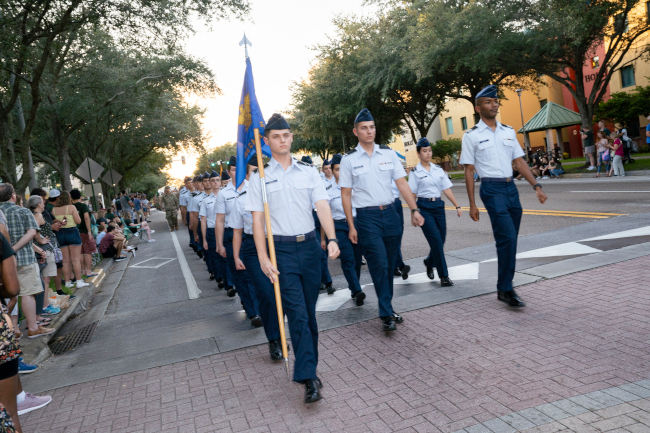 Aerospace Studies - Air Force ROTC Aerospace Studies - Air Force ROTC
C.W. Bill Young Hall (CWY) 407
(813) 974-3367
afrotc@usf.edu
https://www.usf.edu/undergrad/air-force-rotc/
Here at USF, we are Detachment 158 of the Air Force Reserve Officer Training Corps (AFROTC) – Home of the “Flying Bulls.” The AFROTC curriculum we offer includes 16 credit hours of instruction by active duty Air Force officers. A cadet who successfully completes the AFROTC program and a Bachelor’s degree will earn an Air Force commission and enter active duty in the United States Air Force as a Second Lieutenant. AFROTC is offered in a variety of three-to-five year programs and cadets must be enrolled full-time; i.e., carry at least 12 credit hours each fall and spring semester. In addition to their academic work, AFROTC cadets are also required to take a 2-hour non-credit leadership laboratory (LLAB) each semester. Cadets wear Air Force uniforms during LLAB, plan and execute leadership training, and learn Air Force customs and courtesies. Furthermore, AFROTC cadets must attend two physical training sessions on Tuesdays and Thursdays of each week to prepare them to successfully complete the Air Force Physical Fitness Assessment each semester. Physical training sessions are an hour long and begin at 5:45am.
AFROTC scholarships may be available for eligible cadets who meet highly competitive nationwide criteria established by AFROTC Headquarters. The scholarships may pay all tuition, fees, books, and a $300 - $500 per month tax-free stipend. For more information about scholarship criteria, contact us or visit www.afrotc.com for the most current scholarship information. An AFROTC scholarship is not required to enter or even complete the AFROTC program.
Students may join AFROTC at the beginning of the fall or spring semester. To get more information about our program or to start the process of becoming an AFROTC cadet, please contact our Air Force ROTC Office at USF via afrotc@usf.edu or phone 813-974-3367 or visit us in person on the 4th floor of the CWY Building, located just north of the USF Campus Recreation Center GPS 12303 USF Genshaft Drive.
The program is divided into two categories. The General Military Course (GMC) consists of first and second year cadets. The Professional Officer Course (POC) is made up of the third and fourth year cadets. To enter the POC, a cadet must complete Field Training during the summer between second and third year. Field Training is intensive military leadership evaluation and training conducted at Maxwell Air Force Base AL.
General Military Course (GMC)
The GMC consists of four one-hour courses offered in the fall and spring only. Each semester you are in GMC must include a two-hour LLAB and physical fitness sessions twice weekly. It is possible to take these 1-hour courses simultaneously to compress the GMC period from 2 years to 1 ½, or even 1 year. However, the 2-year program is the preferred approach. During GMC, cadets are introduced to the structure and core values of the U.S. Air Force as well as its storied history. Unless you are a scholarship cadet and in your second year of the program, you have no military obligation whatsoever and can leave at any time while in GMC. The program is designed like this so you can see if a career as an Air Force officer is right for you.
GMC Courses:
- AFR 1101 (Fall) – Heritage and Values of the United States Air Force Part 1 (1 credit)
- AFR 1120 (Spring) – Heritage and Values of the United States Air Force Part 2 (1 credit)
- AFR 2130 (Fall) – Team and Leadership Fundamentals Part I (1 credit)
- AFR 2140 (Spring) – Team and Leadership Fundamentals Part 2 (1 credit)
Field Training (FT)
Prior to entering the Professional Officer Course, cadets must successfully complete Field Training (FT) at Maxwell Air Force Base, Montgomery, Alabama which will test their leadership potential. Earning a FT slot is competitive and selection is based on several performance criteria such as GPA, standardized test scores, and Physical Fitness Assessment scores.
Professional Officer Course (POC)
The POC consists of four semesters of three-hour courses offered only in the fall and spring. Each semester you are in POC must include a two-hour LLAB and physical fitness sessions twice weekly. Unlike GMC, the POC cannot be compressed and requires 2 years to complete. POC cadets learn and apply leadership and time management principles and are responsible for the design and execution of all cadet activities. Active duty officers are available full-time to guide and mentor POC cadets to ensure they provide quality training for all the cadets in the program. POC cadets conduct the leadership seminars and manage the cadet corps. To develop POC cadets and prepare them to enter active duty, emphasis is placed on small group discussions and presentations on topics such as management, communication skills and national defense policy. As a POC cadet, you sign an Air Force Reserve contract. This entitles you to a monthly stipend of $300 to $500 during the academic year whether or not you receive an AFROTC scholarship.
POC Courses:
- AFR 3220 (Fall) – Leading People and Effective Communication Part 1 (3 credits)
- AFR 3231 (Spring) – Leading People and Effective Communication Part 2 (3 credits)
- AFR 4201 (Fall) – National Security Affairs and Preparation for Active Duty Part I (3 credits)
- AFR 4211 (Spring) – National Security Affairs and Preparation for Active Duty Part 2 (3 credits)
Both GMC and POC cadets must also enroll in AFR 2001 (Fall/Spring) – AFROTC Leadership Lab (0 credit – S/U grade only)
Just like physical training, all Air Force ROTC cadets must participate in LLAB every semester. LLAB is a cadet-run course that provides excellent opportunities to develop your leadership and followership skills. Our goal in AFROTC is to develop leaders for the Air Force, so LLAB is an essential piece of your development as a future Air Force officer.
Furnished Items
The Air Force ROTC detachment provides all required items free of charge that you’ll need in the program to include a variety of uniforms and all AFR course material.
Air Force Careers
In addition to pilot careers, there are a multitude of USAF career options for officer candidates. To assist cadets in selecting an Air Force career, we bring in active duty officers from various career fields each semester to talk with our cadets. We also visit nearby military bases and coordinate orientation flights in actual USAF aircraft. With this background, cadets can make an informed decision on the career path that interest them most. Competition for flying careers occur in the first year of the POC. The selection for non-flying careers occurs at the beginning of the second year in POC.
Military Science - Army ROTC
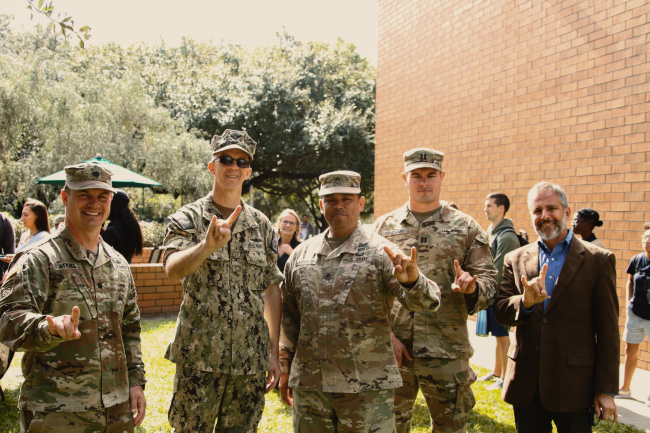 C.W. Bill Young Hall (CWY) 405 C.W. Bill Young Hall (CWY) 405
(813) 974-4065
usofl@usf.edu
https://www.goarmy.com/rotc/schools/university-of-south-florida.html
The Department of Military Science for Army Reserve Officers Training Corps (AROTC) was established to select and prepare students to serve as officers in the Regular and Reserve components of the United States Army. The curriculum is designed to develop students’ leadership potential and improve students’ planning, organizational, and managerial skills.
Army ROTC training is divided into two phases: the first two years constitute the Basic Course; the last two the Advanced Course. The Department offers both a four- and a two-year program, each leading to a commission as a Second Lieutenant in the United States Army. The four-year program requires completion of the Basic Course, a five-week field training course, and the Advanced Course. Students with prior active military service or previous training at military schools may be exempt from some or all of the Basic Course. Students with questions concerning the various options should contact the Professor of Military Science for more information. Enrollment is open to qualified students at all levels, including graduate students. Offerings are published each semester.
Army ROTC training provides scholarships, pay, free uniforms and textbooks for scholarship and/or contracted Cadets. Scholarships are awarded on a competitive basis in all academic majors. The scholarship pays full tuition or room and board, books, lab and mandatory fees, and certain other academic expenses.
Additional Skills Training
Airborne School, Air Assault School, and the Northern Warfare School are available to both Basic and Advanced Course students during semester breaks. Additional skills training is also available during the academic year to include first aid, rappelling, orienteering, etc.
Basic Course
The Basic Course consists of four semesters of classroom instruction of one and a half hour each week and a leadership lab. Students incur no military commitment by participating in the Basic Course. In lieu of attending the basic course classroom instruction, a student may attend the four-week Leadership Training Course at Fort Knox, Kentucky during the summer of the student’s sophomore year.
Advanced Course
The Advanced Course consists of four semesters of classroom instruction of three hours each week, leadership lab, physical fitness and field training exercises, and a five-week training phase at Leadership Development and Assessment Course. Students registering for the Advanced Course must have met all requirements for Basic Course completion. The Advanced Course is designed to prepare the student who desires to be a Professional Army Officer for duty in the Active Army, Reserve or National Guard. Additional training is available to selected Cadets at both US based and overseas active Army units.
Job Opportunities
The newly commissioned Officer can be guaranteed Reserve or National Guard duty, or compete for an Active Duty commission. Prior to commissioning, the student may request to serve in a number of career fields to include aviation, infantry, armor, engineering, medical, law enforcement, logistics, and personnel administration.
Requirements for an ROTC Commission
Students who desire to earn a commission as a Second Lieutenant in the United States Army must meet the following requirements: four semesters of the ROTC Advanced Course, successful completion of the Professional Military Education Courses (written communication skills, computer literacy, and military history), attendance at Leadership Development and Assessment Course, maintain and graduate with a minimum of a 2.0 GPA, successful completion of the Army Physical Fitness Test, compliance with the Army height and weight standards, and other requirements of the United States Army.
Naval Science - Naval ROTC
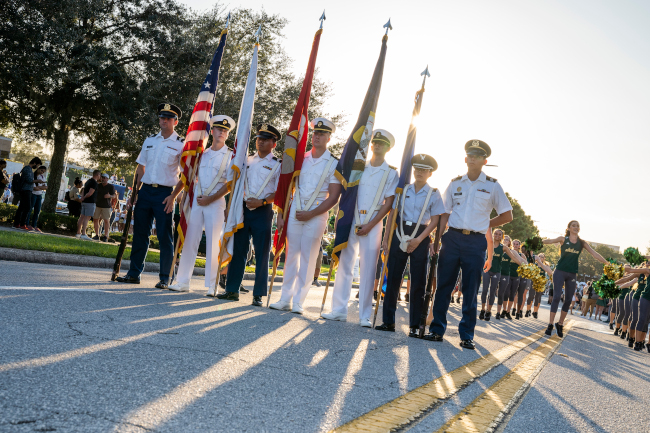 C.W. Bill Young Hall (CWY) 406 C.W. Bill Young Hall (CWY) 406
(813) 974-4789
nrotc-naval@usf.edu
https://www.usf.edu/undergrad/naval-rotc/
https://www.nrotc.navy.mil/
The Naval Science Program at the University of South Florida is administered by the Naval Reserve Officers Training Corps (NROTC) Unit. This program affords selected men and women the opportunity to receive instruction in Navy- and Marine Corps-specific courses which, in conjunction with the baccalaureate degree, will qualify them for a commission in the United States Navy or Marine Corps. Students enrolled in the university who are physically and mentally qualified are eligible to apply for the NROTC program. As naval officers, USF NROTC graduates become eligible for varied careers, serving in aviation squadrons, on surface ships, on submarines in the nuclear power program, at naval installations all over the world, or in the numerous sub-specialties as an officer of the Marines Corps. With the consent of the Professor of Naval Science, any student, although not enrolled in the NROTC program, is eligible for enrollment in naval science courses. The USF NROTC unit offers participation through three programs: (1) the Navy-Marine Corps Scholarship Program, (2) the Navy-Marine Corps College Program, and (3) the Three-/Two-Year NROTC Scholarship Program.
The Navy-Marine Corps Four-Year Scholarship Program
The NROTC National Scholarship Program is open to young men and women of all races, creeds, and national origins who are United States citizens. Students are selected on their own merit to become officers in the United States Navy and Marine Corps. Scholarship students are appointed Midshipmen, U.S. Navy Reserve. The Navy pays for tuition, fees, textbooks, uniforms, and a monthly subsistence allowance of up to $400.00 for four years. Scholarship students are normally selected through national competition during their senior year in high school. Although it is not a requirement, a student in the NROTC Scholarship Program is encouraged to pursue a major in engineering, mathematics, chemistry, or physics to meet the technological requirements of the Navy. Other fields of study for a major leading to a Baccalaureate degree are permitted, with the approval of the Professor of Naval Science. Regardless of the major, every Navy scholarship student must complete one year of physics and one year of calculus.
Students must complete certain Navy- and Marine Corps-specific courses and complete a program of courses as prescribed by the Professor of Naval Science. Upon graduation, and successful completion of the naval science curriculum, the midshipman will receive a commission as Ensign in the U.S. Navy or Second Lieutenant in the U.S. Marine Corps and serve on active duty for a minimum of five years.
The Navy-Marine Corps College Program
The NROTC College Program is designed to train and educate well-qualified young men and women for commissioning. Students in the College Program compete for three- or two-year scholarships which must be earned prior to commencement of a student’s junior year. The Navy or Marine Corps pays for uniforms and naval science textbooks for freshmen and sophomores. Each student is eligible to apply for a two- or three-year scholarship through the NROTC unit based on past academic performance, potential, physical fitness, and advisor evaluations. This scholarship covers tuition, fees, books and a stipend akin to the four-year scholarship. Other students may receive Advanced Standing which only provides a stipend. Those students who do not obtain a scholarship or Advanced Standing by their junior year will be dropped from the program. A college program midshipman only acquires a military service obligation after entering the advanced courses at the beginning of the junior year.
Although there are no restrictions on the major college program students may pursue, it is highly recommended that they pursue a course of study similar to that of scholarship students. Students must complete certain Navy- and Marine Corps-specific courses and complete a program of courses as prescribed by the Professor of Naval Science. Students, upon graduation and successful completion of the naval science curriculum, receive a commission as an Ensign in the U.S. Navy or a Second Lieutenant in the U.S. Marine Corps and serve on active duty for a minimum of three years.
Three-Year/Two-Year NROTC Scholarship Program
The three-year/two-year scholarship program is offered for students commencing their second or third year of college. Applications must be submitted by May 31st during the freshman or sophomore year. Qualifications for acceptance to this program include demonstrated ability to excel in a math, physical science, or engineering major.
Regardless of the major, every scholarship student must complete one year of calculus-based physics and one year of calculus. Students must complete certain Navy- and Marine Corps-specific courses and complete a program of courses as prescribed by the Professor of Naval Science. Upon graduation, and successful completion of the naval science curriculum, the midshipman will receive a commission as an Ensign in the U.S. Navy or a Second Lieutenant in the U.S. Marine Corps and serve on active duty for a minimum of five years.
Summer Training
NROTC scholarship students are required to complete several weeks of training during each summer recess, including the summer before they enter college. NROTC College Program students do not qualify for summer training, except for the summer before they enter college.
The summer before all NROTC students begin college, they will spend approximately three weeks at New Student Indoctrination (NSI) at Naval Station Great Lakes, outside of Chicago, IL. NSI is designed to standardize basic militarization and provide uniform training not available on campus. The training is being accomplished on the same base and in the same facilities that train every enlisted Sailor. NSI provides basic training in five warfighting competencies – Fire Fighting, Damage Control, Seamanship, Watchstanding and Small Arms Handling and Marksmanship – to begin creating basically trained, smartly disciplined, tough and courageous future Navy and Marine Corps Officers.
During the next summer training period, each scholarship student will receive instruction in aviation training, marine combat training, surface warfare indoctrination, and submarine indoctrination in either Norfolk, Virginia, or San Diego, California. The third summer training period occurs aboard operational ships of the U.S. Fleet. During the final summer training period, candidates for the U.S. Navy will perform training aboard operational ships, submarines, or aviation squadrons, shadowing a junior officer. Outstanding midshipmen also have the opportunity to cruise with allied navies through the Midshipman Foreign Exchange Program. During the final summer training period, candidates for U.S. Marine Corps commissions will complete Officer Candidates School (OCS) at the U.S. Marine Corps Base, Quantico, Virginia. OCS is a six-week training program designed to prepare midshipmen for commissioning by providing basic military instruction and physical training. An evaluation of midshipmen is made to ensure that they possess the leadership, academic, and physical qualifications required for appointment.
Transportation costs to and from the training sites, subsistence, quarters, and training pay is provided to every participating student.
Specified University Courses
In addition to satisfying requirements for a Baccalaureate degree, students must satisfactorily complete the following four-year curriculum guide, including required naval science courses and specified university courses.
- All students: NSC 1110 – Introduction to Naval Science (generally taken as a freshman)
- All students: NSC 2231 – Principles of Naval Management I (generally taken as a sophomore)
- Navy options only: NSC 2121 – Naval Ships Systems I (generally taken as a junior)
- Navy options only: NSC 3214C – Navigation/Naval Operations II (generally taken as a senior)
- Marine options only: NSC 3225 – Fundamentals of Maneuver Warfare (generally taken as a sophomore of junior, depending on offerings)
Courses offered in the spring:
- All students: NSC 1140 – Seapower and Maritime Affairs (generally taken as a freshman)
- Navy options only: NSC 2212C – Navigation/Naval Operations I (generally taken as a sophomore)
- Marine options only: NSC 2220 – Evolution of Warfare (generally taken as a sophomore or junior, depending on offerings)
- Navy options only: NSC 3123 – Naval Ships Systems II (generally taken as a junior)
- All students: NSC 4232 – Principles of Naval Management II (generally taken as a senior)
Courses required every fall and spring semester:
- All students: NSC 1101L – 001 – Naval Science Laboratory
- Marine options only: NSC 1101L – 002 – Naval Science Laboratory (Semper Fi)
- Navy options only: NSC 1101L – 003 – Naval Science Laboratory (Blue and Gold)
Depending on a student’s program (e.g., Navy, Marine Corps, scholarship, college program), they will also be required to take non-naval science courses. Examples include courses in calculus, physics, English, military history or national security policy, and world cultures or regional studies.
Furnished Items
All uniforms, textbooks, and equipment needed by the student for naval science courses are furnished by the Navy and Marine Corps.
Use of Navy Science Courses as University Electives
Academic departments within the university may, according to their own policies, accept naval science courses as electives to fulfill requirements in their academic program.
The Joint Military Leadership Center (JMLC)
4202 E. Fowler Avenue, SVC 2002
Tampa, FL 33612
(813) 974-4051
https://www.usf.edu/undergrad/jmlc/index.aspx
Consistent with the mission of the University of South Florida, a global, research university, The Joint Military Leadership Center focuses on preparing future commissioned officers to lead in a joint, multi-national environment through providing and maintaining a unique, state of the art, joint training facility for ROTC; sponsorship of joint activities; and promotion of joint planning and inter-service cooperation.
Programs
The Joint Military Leadership Center develops and implements educational programs to enhance the quality of the ROTC curriculum. Students will gain a better understanding and appreciation for the capabilities, limitations and culture of each military service and the challenges and value of joint operations. These programs include:
- Sponsorship of relevant speakers from the Department of Defense, the Armed Services, Unified Combatant Commands, and the Senior National Representatives of the Coalition at U.S. Central Command.
- An ROTC Living Learning Community (LLC) established in the university’s Housing and Residential Education Department. See https://www.usf.edu/housing/residential-learning/llc-interest/rotc.aspx.
- Student visits to MacDill Air Force Base and Unified Combatant Commands - U.S Central Command (USCENTCOM) and U.S. Special Operations Command (USSOCOM).
- Promotion of cross-cultural competence and study of foreign languages and cultures.
The Joint Military Leadership Center focuses on preparing future commissioned officers to lead in a joint, multi-national environment through providing and maintaining a unique, state of the art, joint training facility for ROTC; sponsorship of joint activities; and promotion of joint planning and inter-service cooperation.
For ROTC Curriculum Programs, please see Undergraduate Studies Curriculum Programs
To schedule an advising appointment:
|